City-Wise Guide · Karachi · Lahore · Islamabad · Rawalpindi
Electric Fence Maintenance in Pakistan — What Your City's Climate Is Doing to Your Wire
An electric fence isn't a set-and-forget installation. Pakistan's three climate zones — Karachi's coastal humidity, Lahore's summer heat and dust, Islamabad's cold winters and rainfall — each degrade a fence differently, and each needs a different maintenance schedule.
Karachi — monthly visits are not optional
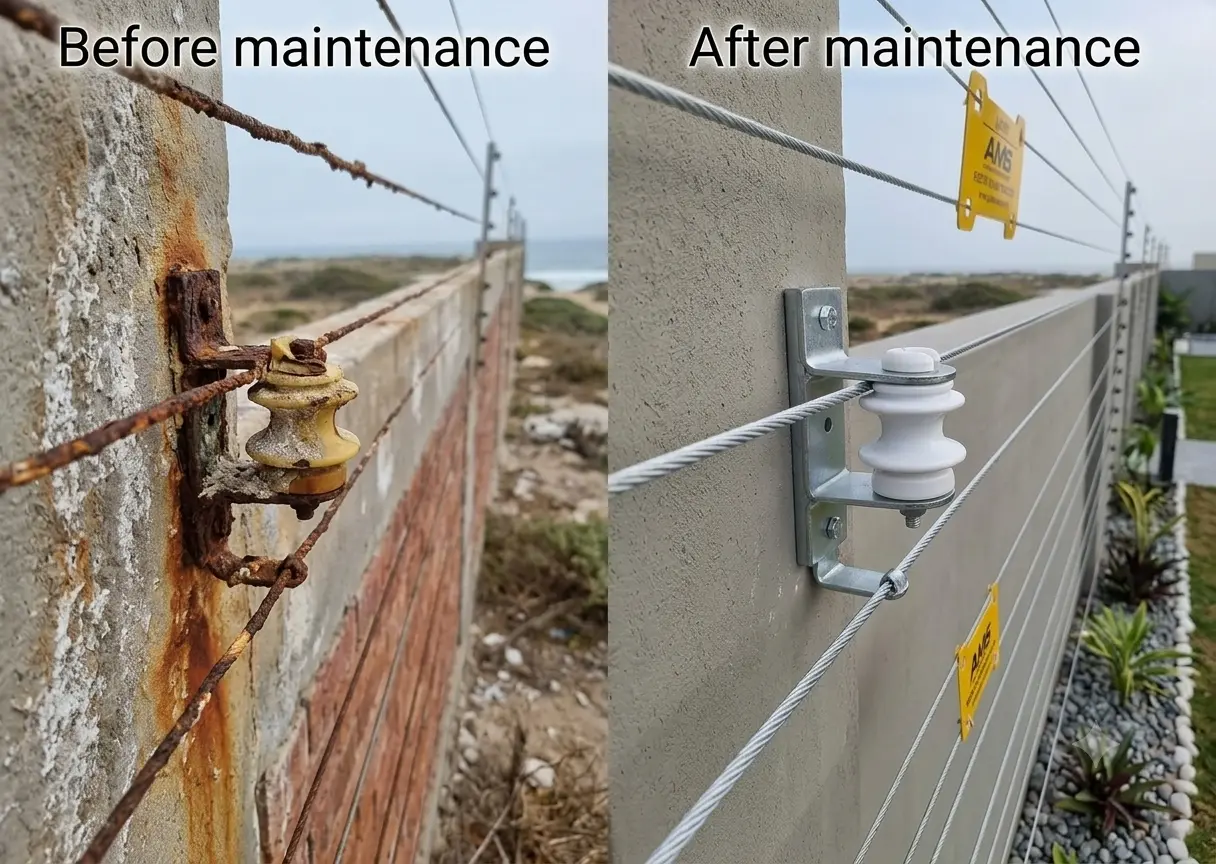
Karachi's coastal humidity is the most aggressive environment an electric fence encounters in Pakistan. Salt-laden air attacks every metal surface — wire, springs, pole brackets, energizer terminals, earthing connections — and it does so continuously, not seasonally.
What humidity does to your fence
- Wire oxidation: Surface oxidation increases wire resistance, which reduces the pulse voltage the energizer can push. A fence that tested at 5,000V on installation day may be delivering 2,500V six months later with no obvious visible sign.
- Insulator tracking: Salt deposits on insulators create a low-resistance path for the pulse to leak to ground. On a humid Karachi morning, you can lose significant pulse energy before sunrise.
- Earthing rod corrosion: Earthing rods in Karachi's coastal soil corrode faster than inland. A compromised earthing rod means the energizer's pulse return path is poor — the system appears to work but delivers minimal shock.
- Spring fatigue: The tension springs that keep wire taut corrode and lose elasticity. Loose wire sags between poles, reducing effective strand spacing — someone can slip a foot through.
Karachi maintenance schedule
Voltage test at energizer output and far-end. Insulator cleaning. Spring tension check. Terminal torque check on energizer board.
Earth resistance measurement. Rod inspection and cleaning. Connection re-torquing.
Replace insulators showing tracking. Replace corroded springs. Wire tension reset. Full documentation.
We don't sell monthly contracts as an upsell — we won't install a system in Karachi without one. A fence with no maintenance contract in a coastal climate is a fence that isn't protecting you twelve months later.
Enquire about Karachi AMC →Lahore — seasonal schedule, wind and heat as the main factors
Lahore's challenge is different: extreme summer heat (energizer box temperatures can reach 60°C inside a south-facing enclosure), dusty winds in spring that coat insulators, and strong monsoon wind loading that loosens wire tension.
Pre-summer (April)
Inspect energizer enclosure ventilation. Check mounting security before hot season heat expansion begins. Test voltage baseline.
Post-dust storm season (June)
Clean insulators after Lahore's dusty spring winds. Dust on insulators can cause pulse leakage similar to humidity, but is easily cleaned.
Post-monsoon (October)
Wire re-tensioning after monsoon wind loading. Heavy monsoon rain also washes away earthing soil contact — check earthing resistance. This is the most important Lahore service visit of the year.
Full annual check (January)
Cold-weather complete inspection. Wire contracts in cold, which can stress connection points and gates. Verify all terminals.
Our DHA Phase 2 office location means Lahore service calls are handled without a mobilisation wait. Phase 5 through 9 — same-day response is typical for active maintenance contract clients.
Islamabad & Rawalpindi — cold, rain, and winter wire contraction
The twin cities present a different maintenance profile: rainfall is heavier and more frequent than Lahore, winter temperatures drop enough to cause wire contraction stress, and the hill-adjacent terrain means some sites experience heavy wind loading year-round.
- Pre-winter tension reset (November): Wire tightened in summer will be over-stressed in cold. A tension reset before the cold months prevents snapped wires mid-winter.
- Post-rain earthing check (quarterly): Heavy rain can create earthing contact issues in rocky or clay soil. Rawalpindi's soil especially can shift around earthing rods.
- Annual full inspection (February): After the full winter cycle, inspect for any cold-induced stress points, particularly at gate brackets and corner mounts.
Our Rawalpindi office is located at Panorama Center, Rawalpindi — serving Islamabad, Rawalpindi and surrounding cantonments.
What every AMS maintenance visit covers
Measured at the energizer terminals and at the far end of each zone. Both readings documented.
Every strand on every run tested for correct tension. Loose wire re-tensioned to spec.
Insulators cleaned and checked for cracks, UV degradation or tracking damage.
Earth rod resistance tested with an earth tester. Should be below 10 ohms; re-driving or adding rods if above.
Springs checked for corrosion and fatigue. Brackets and mounts checked for movement.
All alarm outputs, zone switching and fault indicators tested.
Annual Maintenance Contract (AMC)
Our AMC covers a scheduled number of visits per year based on your city and property type, all consumables from the checklist above, and priority response on fault calls. Karachi contracts include monthly visits as standard.
A maintenance contract also keeps your warranty documentation current — particularly relevant for the AMS German 10-year rust warranty, which requires evidenced maintenance history.
Get AMC pricing for your city →Related guides
Maintenance questions
Most energizers have a fault LED that flashes at a different rate when a significant earth fault or open-circuit fault exists. A change in the flash rate — or the fence alarm triggering more than usual without an obvious cause — is a signal to call us before the next scheduled visit.
You can safely: check that the energizer power indicator is on, look for obvious wire sag or broken insulators, and clear vegetation touching the wires. Never touch the wire with the energizer running, and leave earthing and voltage testing to a technician with the right equipment.
For AMC clients, fault call-outs within the contracted city are at no additional call-out fee — you pay for parts if a component needs replacement. Non-contract clients pay a standard call-out charge. It's usually significantly cheaper to be on a contract.