Legal & Safety · Pakistan 2026 · Honest Answers
Is Electric Fence Legal in Pakistan? Yes — But One Type Can Kill You
The short answer: pulsed electric fencing from approved systems is legal throughout Pakistan. But there's a second type — the cheap local 110V system — that most installers in the market are still selling. That one is not just illegal. It is genuinely dangerous.
Two completely different technologies with the same name
When someone in Pakistan says "electric fence," they could mean either of these — and the difference between them is the difference between a security system and a potential fatality on your boundary wall.
Local 110V Transformer System
How it works
A step-down transformer takes your household 220V AC supply and reduces it to 110V AC. This 110V continuous alternating current is run directly onto the fence wire. When someone touches the wire, they receive a continuous AC shock — not a pulse.
⚠ The fatal failure mode
The transformer has a primary winding (220V) and secondary winding (110V). If the insulation between the two windings degrades or shorts — which happens with age, heat, and moisture — the 220V primary voltage travels directly onto the fence wire that runs around your boundary wall.
At that point, anyone who touches the wire — a child, a worker, a neighbour who doesn't know it's live — receives a 220V AC continuous shock. This is not a deterrent. This is electrocution.
Why it's cheaper
A transformer costs a fraction of a purpose-built pulsed energizer. The installer passes on that saving and pockets a larger margin. The risk stays with whoever lives behind the wall.
Pulsed Energizer Systems
Tongher (Taiwan) · Nemtek (South Africa) · AMS German
How it works
A purpose-built pulsed energizer delivers a short, high-voltage burst onto the fence wire approximately once per second. Between pulses, the wire is not live. Each pulse lasts roughly 1/300th of a second — long enough for the deterrent effect, too short for the current to cause ventricular fibrillation in a healthy adult.
Why pulsed systems are safe
- The pulse duration is engineered to be below the cardiac fibrillation threshold
- The energizer's internal circuit cannot allow mains voltage onto the fence wire — it's galvanically isolated
- If the fence shorts to earth, the energizer detects the fault and modifies output — it doesn't push mains power through the fault
- All three approved systems carry international safety certifications (CE, UL, or equivalent)
Required with any legal system
- Warning signs at intervals no greater than 10 metres, clearly visible from outside
- Signs must include the universal electric fence warning symbol
- Energizer must be in a locked or restricted enclosure
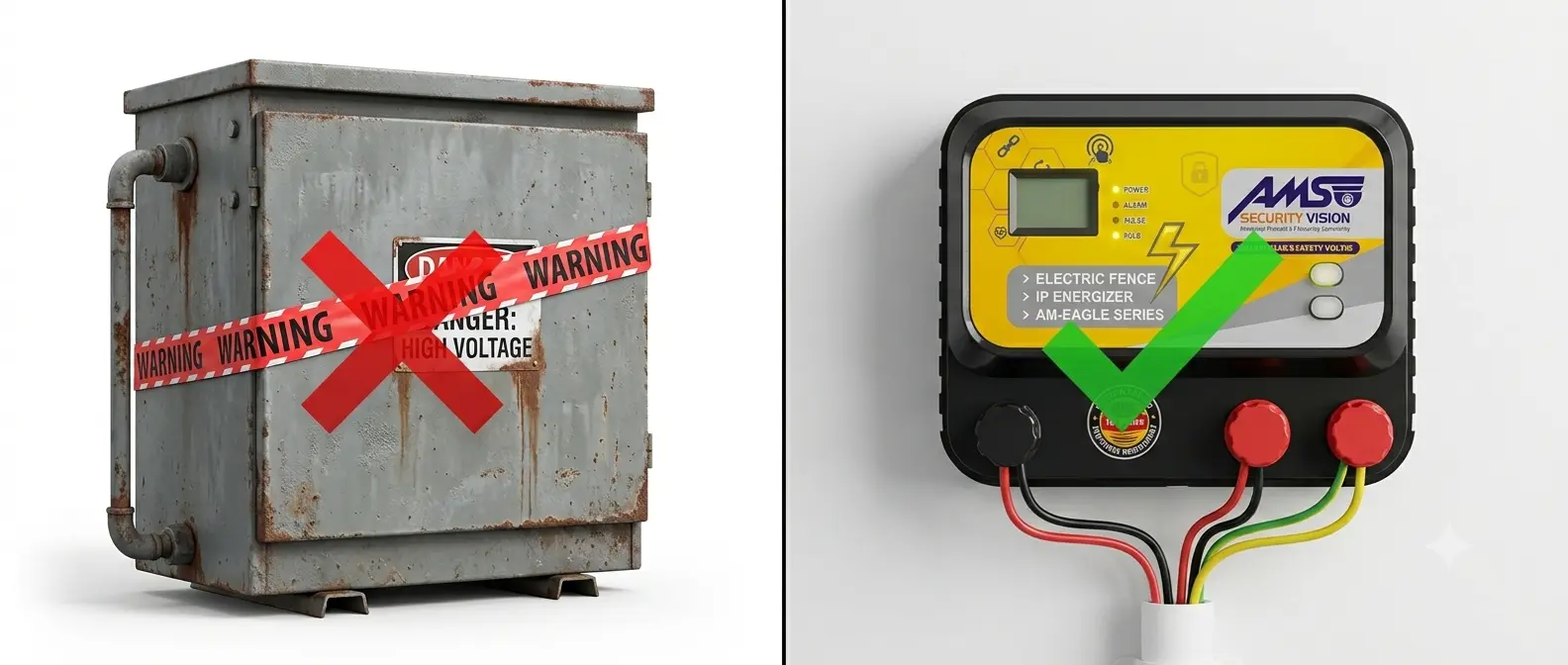
How to tell which system you already have
If you have an electric fence installed and aren't sure which type it is:
Signs of a 110V transformer system
- No brand name on the energizer box — often a plain metal box or locally welded enclosure
- Wire goes directly from the box to the fence with no obvious pulse — it feels like constant contact if you brush against it (don't test this)
- The installer could not give you a warranty document with a brand name
- No visible pulse indicator light on the energizer
Signs of a legal pulsed system
- Branded energizer (Tongher, Nemtek, AMS German) with model number visible
- Flashing LED on the energizer face — pulses approximately once per second
- If you can hear it, a light "click" at regular intervals from the energizer box
- Written warranty documentation provided at installation
Unsure about your existing system? WhatsApp us a photo of your energizer box — we'll tell you what you have, no charge and no sales pressure.
Send photo on WhatsApp →Legal status summary
| System | Technology | Pulse or continuous | Pakistan legal status | International certification |
|---|---|---|---|---|
| Local 110V | Step-down transformer | Continuous AC | ❌ Illegal | ❌ None |
| Tongher (Taiwan) | Pulsed energizer | Pulsed (~1 sec interval) | ✅ Legal | ✅ CE / equivalent |
| Nemtek (South Africa) | Pulsed energizer | Pulsed (~1 sec interval) | ✅ Legal | ✅ CE / SANS 10222 |
| AMS German | Pulsed energizer | Pulsed (~1 sec interval) | ✅ Legal | ✅ CE / German engineering spec |
Related guides
Legal questions
Potentially yes. If an illegal 110V system injures or kills a person — including an intruder — the owner may face criminal and civil liability, particularly if the system has no safety certification and warning signs were absent. This is an area where you should consult a lawyer for specific advice; we can only speak to the technical and installation side.
There is no single specific electric fence regulation in Pakistan as of 2026. However, general electricity safety provisions in the Pakistan Electricity Act, and local government by-laws in major cities, apply to any electrical installation on private property. The illegality of the 110V transformer system stems from the absence of any type approval and its violation of basic electrical safety principles, not from a named electric fence law.
Yes — in most cases the existing wire and poles can be reused. The transformer is removed and replaced with a properly rated pulsed energizer, new earthing is installed to the correct specification, and the system is tested. This is significantly cheaper than a full reinstall. Contact us for a conversion quote — see our pricing guide for brand options.
Replace an illegal system before it becomes a problem
Conversion from a 110V transformer to a pulsed system takes one day. We'll quote the work, reuse existing wire where it's still in good condition, and give you proper documentation.